I want to easily use wired earphones/headphones with good sound on my smartphone.
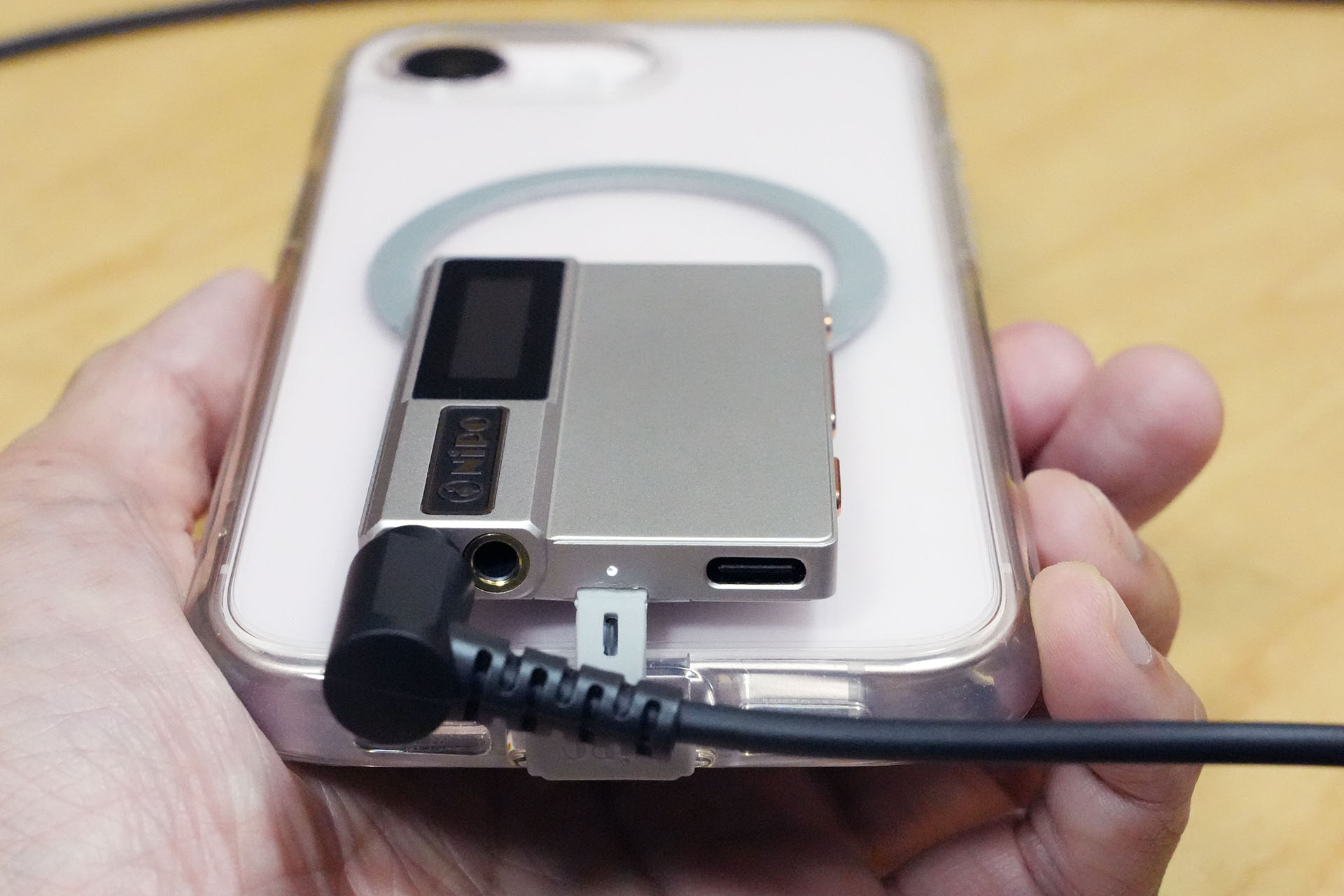
When listening to music on your smartphone, even if you want to use your favorite wired earphones or headphones, there is no earphone jack… In such cases, it is quick and easy to use a portable amplifier with a DAC. However, it is difficult to carry around a large amplifier along with a smartphone. The NiPO “COCOM1” introduced this time can be easily used by attaching it to the back of your smartphone with a magnet.
Thin and lightweight, with smart connection cables. In fact, it may be more comfortable to use than a stick-type DAC that dangles around. The author, who regularly uses the iPhone 17e, tried using it and will report on the appeal of COCOM1.
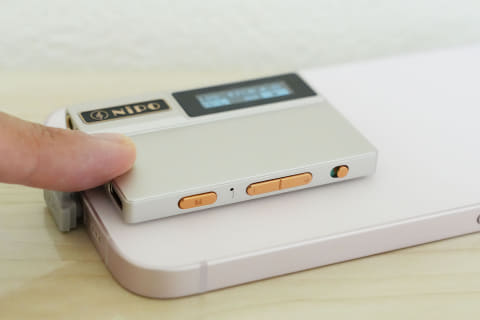
NiPO「COCOM1」
“Thinner”, “Lighter”, “More everyday”
NiPO COCOM1 has been on sale since June of this year, and the price is open and the actual price is around 47,300 yen.
NiPO is an audio brand based in Shenzhen, China that mainly develops DAC amplifiers that can be used with smartphones, but also develops DAPs. COCOM1 is about half the price of the previously reviewed high-end model “A200PRO” (actual price: around 89,980 yen), and is also significantly smaller in size. The cable for connecting to the smartphone is not attached externally, but is integrated into the main body.
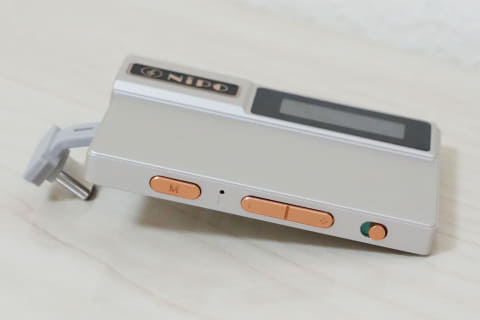
Developed with the aim of being “thinner,” “lighter,” and “more suitable for daily life,” its eye-catching weight of 28g and ultra-thin body of less than 7mm make it easy to forget you’re wearing it. The OTG cable uses a special flexible PCB to minimize the connection terminal area.
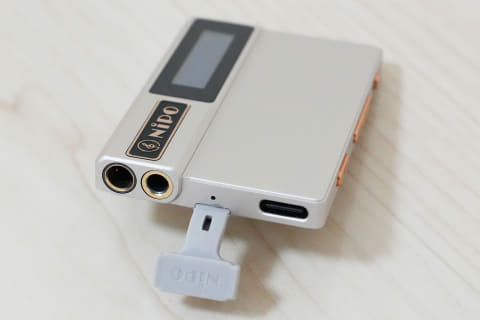
An OTG cable using a special flexible PCB is integrated into the main unit.
The stress of having to search for the product in your bag and connect it to your smartphone every time you use the DAC amplifier was common to conventional DAC amplifiers. Whether it’s a stick type or a type that can be stacked on the back of a smartphone, the reality is that there hasn’t been a product that is large enough to be left on all the time.
COCOM1 is compact enough to be carried in your pocket while attached to your smartphone. The outer dimensions are 60mm on the longest side, 41mm on the shortest side, and 6.3mm thick at the thinnest part.
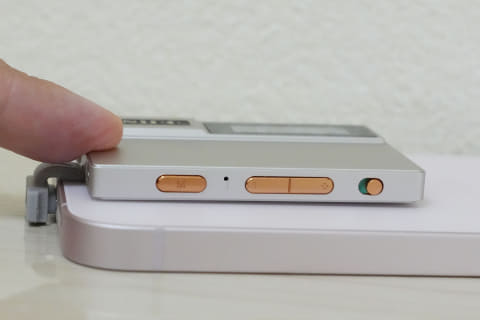
This thinness even when layered with a smartphone
Although it is thin, small, and light, its specs are surprisingly reliable. Format supports up to PCM 768kHz/32bit and DSD native DSD 512. Since ASIO’s own driver is not distributed, DoP playback is limited to DSD 256, and DSD 512 can be played with USB Audio Player PRO or HiBy Music Player.
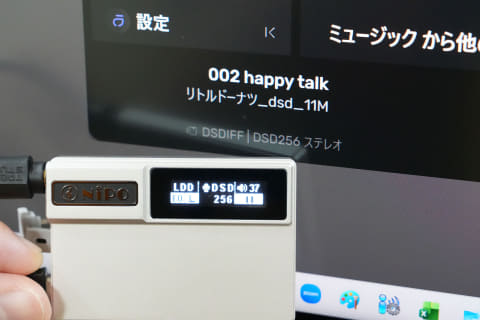
DSD native Supports up to DSD 512 (DoP playback up to DSD256)
The output has 3.5mm and 4.4mm terminals, and achieves an output impedance of 0.22Ω and a maximum driving power of 500mW (at 32Ω load). The 3.5mm jack also allows digital output using a 3.5mm 4-pole to RCA coaxial digital cable. The power source is USB bus power.
Adopts the patented structure “CMMT”, which is also used in higher-end models, and the dual “SGM8262” operational amplifier. The DAC chip has a built-in “AK4493SEQ”. You can choose from 6 types of DAC filters and 6 types of EQ (you can also turn it off). There are two types of gain: low gain and high gain.
Unique USB-C connection
Input is USB-C. Actually, this is a unique specification that I would like to explain, but first, the USB input differs between PCs and mobile terminals such as smartphones.
When connecting to a mobile device, the proprietary FPC OTG cable that is integrated with the device comes into play. It has a structure that continues to be integrated with the device, reducing the frequency of insertion and removal and suppressing physical wear. It seems that they have also succeeded in extending the product life. Some people may be worried about the appearance, but it uses a specially reinforced inner membrane structure, and has passed tests of over 10,000 plugging and unplugging of connectors and 2,000 bending of cables.
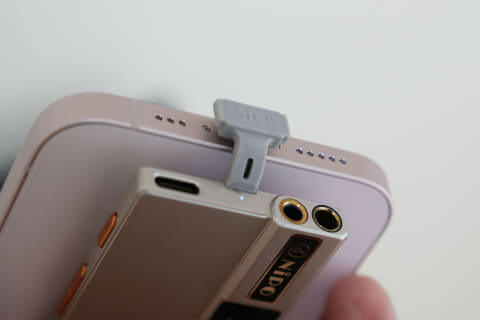
Output is 3.5mm and 4.4mm terminal
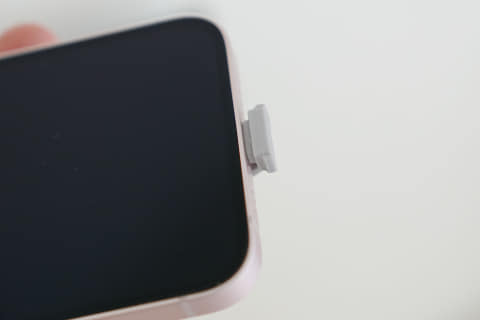
The protrusion of the plug connected to the smartphone is also suppressed.
On the other hand, when connecting to a PC, you can use the USB-C port on the side of the main unit. The drive selector switch on the main unit is the PC on the side where the red color is visible. The side where you can see the green color is the mobile terminal. When connected to a mobile device, turn the switch to the red side to avoid wasting the device’s battery. Only when you use it, switch it to the green side to turn on the power. As this is a product that is meant to be attached to your smartphone at all times, great care has been taken.
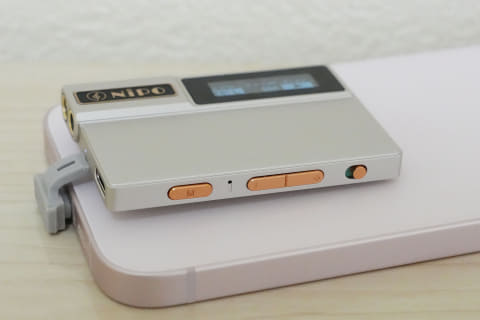
The slide switch on the right side of the side is for switching the drive. The side with the green color is for connecting to a mobile device, and the red side is for connecting to a PC.
When connecting to a PC, switch to the red side and connect with a USB cable, and the PC will recognize it as an audio device. According to Windows specifications, the default format for sound settings is up to 384kHz/32bit, but if you use an app that supports exclusive mode such as Audirvāna Studio, you can play up to 768kHz.
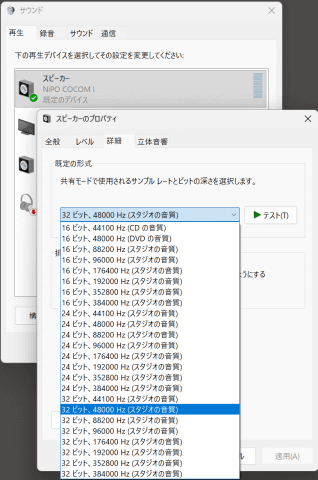
Windows sound settings up to 384kHz/32bit
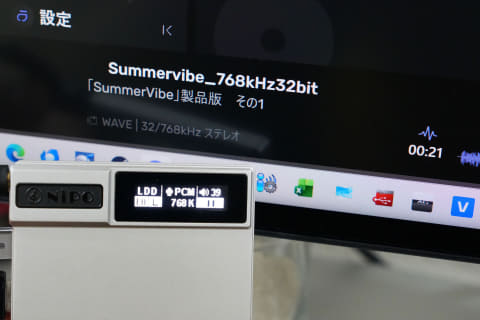
If you use an app that supports exclusive mode such as Audirvāna Studio, you can play up to 768kHz.
If you supply power from the USB-C port while connected to a smartphone, it is also possible to perform pass-through charging at up to PD60W. Of course, you can continue playing music.
When connecting to a smartphone, the built-in magnet is used to firmly attach it to the smartphone. It uses an N52 grade high-magnetic neodymium magnet, and is used by attaching it to a mobile device with the included metal plate attached.
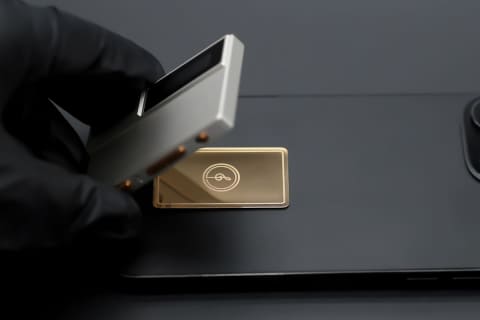
Attach the included metal plate to your smartphone and magnetically fix COCOM1 to the plate.
I attached a metal ring to the case with MagSafe charging in mind, so I was able to secure COCOM1 magnetically, but it would shift if I pressed it a little with my finger. However, COCOM1 itself is lightweight, so I had my smartphone with me and COCOM1 did not fall off.
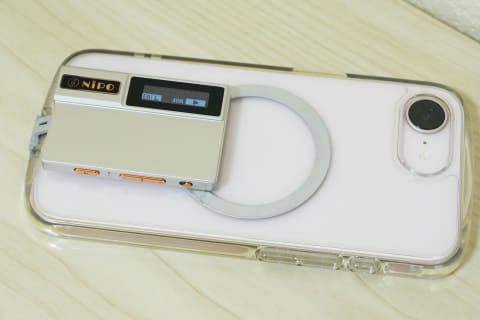
It was also possible to fix the smartphone case with a metal ring for MagSafe charging.
The basic way to use it is to either attach a metal plate to a case that does not have a metal ring attached, or to attach a metal plate to a smartphone without a case.
As you can see, the photo shows the main unit temporarily installed on a smartphone with the case removed. If you actually attach the metal plate, it will be firmly fixed without any gaps, as shown in the photo when you press it with your fingers.
The magnetic force is very strong. When connected to a PC, it was firmly fixed to the metal part of the arm stand that holds the PC. With such a strong magnetic force, it is hard to imagine that it would come off the smartphone without permission.
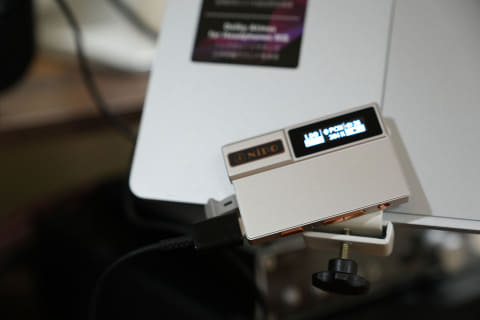
When connected to a PC, firmly secure it to the metal part of the arm stand that holds the PC.
Designed with an emphasis on sound quality, taking into consideration clocks and power supplies.
The operating system is located on the side. These are the aforementioned drive selector switch, volume (+/-), and menu button. A microphone is placed between the menu button and volume button. The menu access and selection/decision flow is the same as the A200PRO, making it easy to get used to. The display is equipped with a 0.87 inch OLED display. This is extremely easy to see. It’s frustrating that the photos don’t convey the visibility at all.
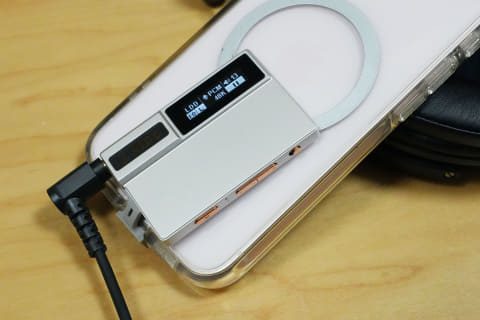
OLED display has good visibility
One thing that bothered me was that the screen would turn off unintentionally. When operating the menu, items are moved by pressing the menu button, but if the tempo is fast, it will be judged as a “double press” and the screen will disappear. I would like to see a firmware update to fix the issue where the screen disappears when you press the menu button to get to the desired setting quickly. It seems likely that this problem will be resolved if the interval between double-press judgments is shortened a little more.
There are a wide variety of ways to improve sound quality. First of all, we are particular about the clock. By combining the femtosecond class ultra-low phase dual crystal oscillator Accusilicon’s “AS318-Lite” with our unique fully synchronous operation, we control the timing of digital signals with high precision. Clock jitter has been suppressed.
Also, consideration has been given to the effects of bus power. Thoroughly cleans power supply noise and high frequency interference that are unique to mobile devices. The aim is to achieve stability by placing an individual ultra-low noise power supply IC in each circuit. There are nine independent power sources.
In addition, the internal components also demonstrate a commitment to sound quality, including the use of multiple military-grade capacitors made by Panasonic and Vishay.
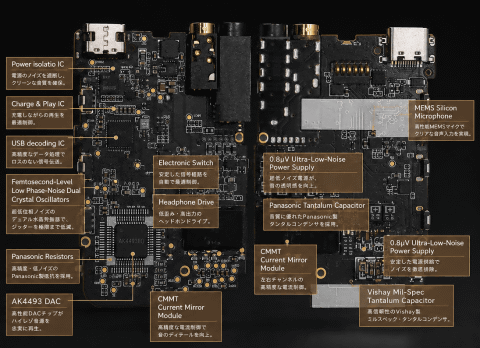
internal board
listen to the sound
Now let’s listen to the sound. First, connect it to your computer with a USB cable and start Audirvāna Studio. Select Kernel Streaming, which has the best sound quality in the app. The device name was “NiPO COCOM I”. The reason why 1 is changed to I is unknown.
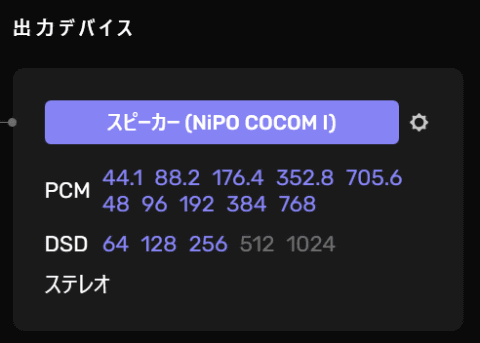
Trying out the 4.4mm connection with the monitor headphones “T3-03”. Beagle Kick’s 768kHz/32bit sound source “SUMMER VIBE”. A song that pursues smoothness that approaches the limits of PCM by recording an acoustic jazz session at ultra high rate. I was first drawn to the thick sound images of electric guitars and acoustic basses. The room reverb of the trumpet makes you feel the space of the room. The rhythm of the cajon is sharp and steady.
Suara’s DSD 11.2MHz sound source “Kimi no Kawari”. Vocals that make you feel moist and moist. It has both the precision of transients and the texture that eliminates the digital smell that is unique to DSD. The organic texture of the grand piano is also exceptional.
View ABEMA in your browser. Watch anime and variety shows. There is no peculiarity in the band balance, and it is flat. I tried changing the cables to 4.4mm and 3.5mm, but the 3.5mm felt a little lacking in volume in the mid-low range. 4.4mm not only gives you a good sense of volume, but also gives you plenty of driving force, making it feel like it’s making a lot of noise. I also like the fact that it’s not excessive and doesn’t upset the balance.
In addition, the left and right separation has been improved, reducing the overall turbidity of the sound field. Separation is also improved. In variety shows, room reverb has become more realistic. Even in anime, the ability to express space has improved.
Check it on the go. I air check the programs I recorded on the train. I listened to programs transferred to SONY’s Video & TV SideView using IE 400 PRO (3.5mm connection).
There is no problem with fixing it to your smartphone even when you are out and about. However, since the size of my smartphone and the position of the metal ring I attached happened to be safe for fixing COCOM1, I basically recommend using it with the metal plate attached.
When I carried it around, I felt no stress in terms of size. The fact that there is an object on the back of the smartphone may be a little bothersome at first, but you will gradually get used to it.
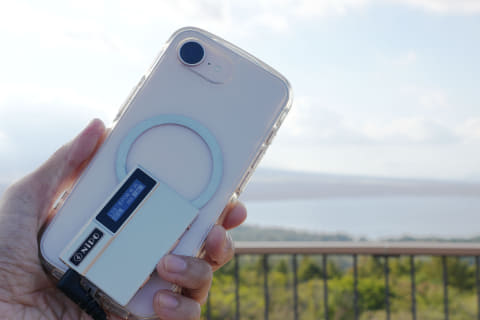
The only thing that bothered me was that the center of gravity was slightly unbalanced. One reason is that the iPhone 17e was a light smartphone, but because the body is so small, only the connected side feels a little heavier, and when you hold it in your hand, you can feel the center of gravity change. I think this is something I’m used to, but I’d like to mention it for reference.
Now, let’s watch videos with Video & TV SideView. I usually listen to music using a small, lightweight stick-type DAC amplifier. Compared to that, COCOM1’s clear sound image and high signal-to-noise ratio almost made me sigh.
The sound tendency is similar to that of the higher-end A200PRO, and although it is slightly inferior in detail reproduction of the sound image and margin in the mid-low range, it is flat and undisturbed, and its detailed descriptive power makes you doubt its size. While the resolution exceeded my expectations, on the other hand, I could hear the crunching sound characteristic of compressed sound sources even on the train.
Also, I would like to point out the margin of driving force and the high linearity of the dynamics. The actors’ performances are more dynamic and delicately reproduced, allowing you to fully immerse yourself in the world of the work. It has excellent dynamics expression, so you’ll want to turn up the volume and listen to even the smallest, detailed sounds. Sound images such as SE have a more three-dimensional feel and are more persuasive.
You can enjoy this level of sound with bus-powered equipment. What’s more, having a device that doesn’t cause stress even if you leave it attached to your smartphone all the time is extremely appealing.
To be honest, considering the noise inside the train, I didn’t expect the sound quality to be that high for the air check. However, if operation is so easy and stress-free, you’ll want a higher-grade sound.
When I got home, I checked the local sound source and streaming sound source combined with my smartphone.
In addition, when viewing with a PC and listening with a smartphone, there was an issue where the beginning of the playback was slightly missing. It occurs regardless of the type of app or browser, and the length can be as short as less than 0.5 seconds, and depending on the app, it can be as short as 1 second. If you send songs with the same sampling rate, no head clipping will occur.
This seems to be a specification to prevent noise when switching sampling rates, but I hope this will be improved with a firmware update.
I used ONKYO HF Player and Qobuz to listen to local sound sources and downloaded sound sources transferred to the main unit. Overall, it showed high performance despite its small, lightweight body and bus-powered power supply. The sound image has excellent three-dimensionality and granularity, and the band balance is realistically natural.With 4.4mm, the driving force in the mid-low range feels even more spacious, and the dynamics are delicate and lively.
The textures are also blended just right to make listening to the music enjoyable. The organic feel of vocals and acoustic instruments added a sense of comfort and comfort to the sound of this unit, which at first glance tends to be thought to be unparalleled in accuracy.
If you look up, there is no limit, but there were times when I felt that the S/N ratio needed to be a little higher for songs with fewer sounds. In addition, the detailed expressiveness of the sound image seemed to be able to become even more sharp, allowing us to see the finer details of the instruments.
“Concert: Queen’s Blood” from “FINAL FANTASY VII REBIRTH Orchestra World Tour LIVE”. Listen and compare 3.5mm and 4.4mm.
3.5mm is not enough, but 4.4mm gives the sound even more depth, and in a good sense, it has a higher level of fleshiness. Perhaps because there is more leeway in the driving force in the mid-low range, the instantaneous power and horsepower in the mid-low range are increased even at similar volumes, giving a different sense of excitement when listening to a performance.
The reverberations of drums and percussion in the hall were so realistic that you could feel the spaciousness of the space. Thanks in part to this unit’s excellent clock system, the sound field is not only wide, but also reaches a level where you can naturally imagine the situation in which it was recorded.
“Ready Your Weapon” from the TV anime “Funeral Freeren” Season 2 Original Soundtrack. Try switching the DAC filter. Although the change in sound quality is slight, I personally recommend AKM’s new original filter “Low-dispersion short Delay Filter (LDD)” if you can’t decide.
LDD is a filter with well-balanced impulse response, phase characteristics, and frequency characteristics. The rise and fall are clear, separation is improved, and spatial reproducibility is improved.
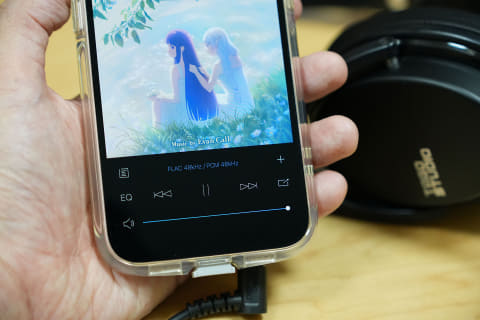
The sound of the strings located on the left has a moderate amount of sparkle. Percussion and bass that make the bass roar create a powerful performance. Even though it’s bass-powered, it doesn’t have a sloppy sound. I also liked that the unique texture of the folk instruments that adorned the Celtic-style music exuded just the right sense of temperature and warmth.
Listen to Nanawo Akari’s “Pi” from Qobuz. The chorus has a high resolution and tickles both ears. The pop pico-pico synth and the grinding bass coexist without fighting. The separation of the vocals is very clear and comes easily to the ears.
“Jazz Standard ~Real Book Page 564~” from the restarted digital single of SANOVA. Jazz piano has a fast-paced feel, and the sound has a nice structure. It has a bounce-like momentum and sharpness.
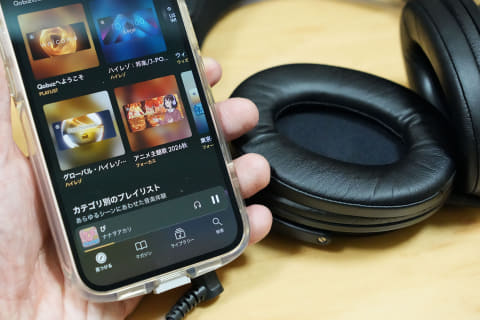
“Volver (Homecoming)” from bandoneon player Ryota Komatsu’s album A la Parrilla is a duo of guitar and bandoneon. The grain of the guitar is detailed and captivating. The bandoneon shows the presence of an acoustic instrument without being overshadowed by the small sounds of buttons and the sounds of bellows expanding and contracting, and the sound of the air is so realistic that you can almost feel it as an instrument right in front of you.
The recording and mixing should be good, but the good channel separation of 4.4mm should also contribute to the three-dimensionality and airiness of the sound image. In addition to the difference in driving force, balanced connections also have an advantage. If possible, I would like you to connect it with 4.4mm and enjoy it.
Comfortable to leave on, yet another dimension of sound
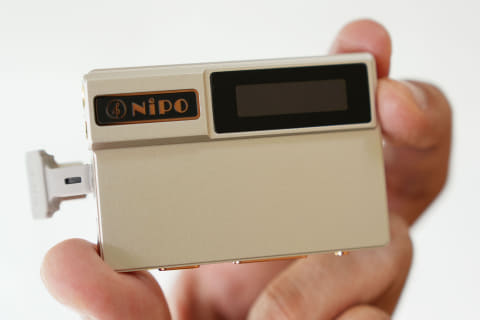
Thanks to its lightweight and compact body and flexible OTG cable, COCOM1 has achieved a new type of usability that allows you to use it comfortably even if you leave it on all the time.
It is also equipped with convenient functions such as pass-through charging and power off so that you don’t get stressed by leaving it on. Although I did not try it in this article, it is actually possible to switch between UAC1.0/2.0, so it can also be used as an external DAC for game consoles.
Don’t underestimate the sound quality just because it’s small and USB bus powered. Enjoy a mobile audio life on a different level than with cheap stick DAC amplifiers. However, if it becomes comfortable to leave it on all the time, you might want to seriously consider it.